
As IPv4 additionally has the choice to combine IPSec, we are able to assume that IPv4 versus IPv6 when it comes to safety is sort of the same. The IPv6 was developed having security in thoughts. Windows Vista and newer variations of Home Windows, fashionable versions of Mac OS X, and Linux are compatible with IPv6. For instance, these two protocols are capable of run in parallel. Users wouldn’t be ready to entry many of the web sites or applications, and we might have an enormous mess on the web. Think About suddenly altering the IP handle of every device.
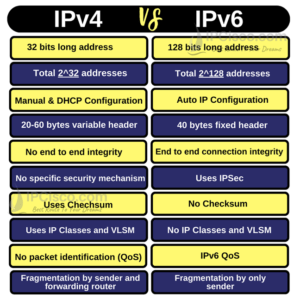
Ipv4 Vs Ipv6: Their 11 Key Differences (updated)
To access the general public web, units with private addresses require a complex and resource-intensive workaround referred to as network tackle translation (NAT). Devices on non-public native networks utilizing these 18 million IPv4 addresses haven’t any direct path to the general public internet. Nonetheless, to assist with the transition, most internet service suppliers and cloud providers are operating dual-stack networks, IPv6 tunneling, and network address translation 64/domain name system 64 (NAT64/DNS64) conversion. As the number of internet-connected gadgets grows, there have to be available IP addresses to offer connectivity, which spurred the creation of IPv6. Though IPv4 at present connects many units across the globe, its 32-bit nature means there’s a finite variety of available IP addresses. Internet protocol (IP) are communication rules that help ship data packets over the web to particular addresses.
Ipv4 Vs Ipv6 Speed:
Not all addresses are convertible So, this vary functionality solves the tackle allocating downside, and you could get rid of the difficulty of not having enough addresses, at least for the close to future. This substantial difference leads to IPv6 providing 1,028 instances extra addresses compared to IPv4. The main distinction between IPv4 and IPv6 lies within the tackle measurement, with IPv4 using a 32-bit address and IPv6 utilizing a 128-bit handle. Both types exhibit vital variations. When IPv4 could not keep up with the demand, they made IPv6 to completely clear up the problem of not having enough addresses.
- The distinction between IPv4 and IPv6 is with the inner local addresses or private tackle area.
- Although it is still what holds the Web collectively, IPv6 (its newer version) is slowly gaining curiosity.
- This makes IPv6 tackle administration rather more simple in addition to retaining IP addresses across Droplets, improving service continuity, and having more control over your network.
- Although IPv6 adoption is slow and steady, it’s essential for organizations as the world turns into extra related.
Out There Area In Ipv4 Vs Ipv6
Since the Nineteen Nineties, there have not been sufficient IPv4 addresses for the Web. IPv4 was designed to deal with four.3 billion addresses, an enormous number that was greater than enough in 1980. With IPv6, there’s a vast and virtually limitless provide of potential addresses, ensuring AlexHost SRL the continued progress and growth of the Internet.
Nejnovější komentáře